Sound Effects are a Universal Language
 Sound Effects are a Universal Language
`Sound effects are the sonic language of our world; they communicate to us the speed of a train, the force of a kick or simply the presence of another around us. Anthropologically sound acted as the feelers used by humans in attempting to navigate the unknown. It is the intention of this essay to show how sound effects pray on that very same sonic-safety mechanism which gave us the ability to survive. The genre of Horror uses sound effects greater than any other genre. It does this by infiltrating the emotional response systems of the viewer, engaging on both a conscious and subconscious level. Sound effects are used in horror to; 1) establish the reality of the world in order to consciously infiltrate our psyche, 2) manipulate our emotions, 3) pander to the darkest part of our imagination and finally 4) subvert the way in which we sonically understand and navigate the world.
Establishing reality in Horror
In Tobe Hooper’s 1974 ‘Slasher’ film The Texas Chainsaw Massacre the infamous sound of the chainsaw is a reality that immediately strikes fear into the listener, be in wielded by the monstrous Leatherface, or by a landscape gardener, the effect of such a loud dangerous machine is one which we instinctively identify as being something to fear. As Jerry (Allan Danziger) enters the parameter of the house the drone of the engine powering the electricity tells us some reasonably obvious information, namely that the house is occupied and, given that it is still running and that they have gas that the protagonists need. Thus this sound effect drives the plot using ‘localizable’ sound which, “shares with the un-identifiable noises the quality of bringing the material aspects of reality into focus”.(Kracaucer,124) However as he enters the house the sound of pig screams over the din of the machine indicates to us an element of danger is clearly beyond the door. The sound of the engine is later mimicked by the roar of Leatherface’s chainsaw as Sally (Marilyn Burns) is chased through the woods. The sound effect has sonically engaged us literally, carrying the narration, giving reason for Jerry to have entered the house, but it has also engaged is on an animalistic level. We now associate the sound of the engine with danger, the sound of the house with danger and very obviously, (unless one is emotionally stunted) the sound of Leatherface’s chainsaw, with danger.
The Emotional Level
Sound effects do not simply speak to us in a narrative manor by establishing certain realities they also have the ability to engage us emotionally. Walter Murch in his rule of six identifies emotion as the paramount criteria in editing, and in horror no effect speaks to our subconscious with the same depth as the language of sound effects. Take the speech by the two eerie twins of Stanley Kubrick’s The Shining, as the camera follows the push cart of Danny ,the words resonates with our subconscious when they are said in unison carrying more weight than any scream can, toppling the clichéd scream as the classic sonic indicator of danger. Here it is not the dialogue which makes us shudder but rather the combination of cuts between the images of the butchered girl, mimicking the uniformed speech of the two. This is what Siegfried Kracaucer called ‘pure dialogue’, when dialogue is removed from having simply a narrative effect (Kracaucer, 107). We can see the diegetic presence of their voices carrying the shot, as the non-diegetic soundtrack as well the camera shots take their lead from the sound effects.
Robin Hardy’s 1973 The Wicker Man also makes use of diegetic sound in the same way, with the on screen sound dictating the shot. As Edward Woodward sings his prayers inside the bowls of the human effigy, the conflict between his own fear and fruitless defiance is drowned out by the song of the pagan villagers. The scene’s harrowing final shot as the camera pans to the setting sun shows us that the song of the villagers has won. This terrifying scene relies totally on the sound effect of the singing villagers whose celebration not only acts as a sound effect but also as the soundtrack to the scene, where one can only look on in helpless terror as Woodward is sacrificed for the crop. Emotionally it is hard for any film of any genre to live up to that level of emotional engagement, as the sound effects of the voices create a harrowing realisation that our hero will not be saved.
Fearing What We Cannot See
To return to the anthropological understanding of sound, fear of the unseen or un-known will all ways resonate louder with our subconscious than any on screen effect, we will all ways fear what we cannot see. As a result where eyesight fails, our hearing then acts as our tool of navigation when assessing danger. Daniel Myrick’s horror film The Blair Witch Project uses an acute understanding of these animalistic truths about our own ability to sense danger. The sound effects used by Myrick in the ‘found footage’ style were used knowing that the power of our own imagination can never be surpassed by special effects, and rather than focus on the visceral violence of previous ‘found footage’ films such as Cannibal holocaust, the films directors knew that the most eloquent language of horror was to avoid such blatant depictions of horror and to allow the language of the sound effects narrate the terror. It plays on a kind of ‘individualistic nightmare’ which only we ourselves can conjure; the effects merely act as a trigger to that nightmare. The final scene, as we hear the crew screaming in terror to one another never shows us the root of the terror but allows our imagination and our empathy for the screaming crew to create the nightmare.
How Horror’s Sonic Language Subverts
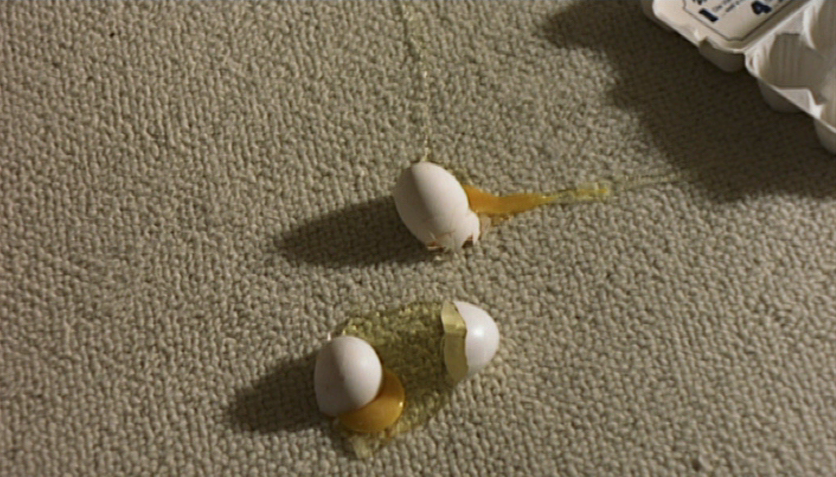
Thus far this essay has shown how the universal language of sound effects can be used to manipulate our understanding of the world, our emotions and our imagination. We have however yet to come to what this essays believes to be the most interesting function of sound effect in Horror, i.e. its ability to subvert our animalistic understanding of the world. In no film does the language of sound effects manipulate such understanding as Michael Haneke’s Funny Games. The sparse if not absent use of non-diegetic sound, other than possibly the opening soundtrack leaves a void of space to be filled by Haneke in order for the audience to navigate, empathise and imagine the horror that falls upon the family at the hands of ‘Beavis’ and ‘Butthead’. The dropping of the eggs scene turns what would have been simply a narrative sound effect into what could be argued to be one of the scariest sound effects used in the film. Not only does the crack indicate an ambiguous refusal of the killer to leave but also mimics the crack heard as the father is rendered incapacitated. Here is a language we are not familiar with, a sound effect which not simply drives narrative but which is a precursor to the violence we are about to witness.
The same could also be said about the rolling of the golf-ball which signals the killers return to the house with the wife captive, or even the drone of the television as their decapitated son lies dead. These sound are not the traditional sounds with which we could understand the world, but in the ‘ultra-violence’ of Haneke’s world, these have become the new scream, the new rustle of leaves subverting everything we knew about the sonic language of sound effects.
The language of Sound Effects is universal, and each category we have discussed only acts as a microcosm of the overall effect sound effects have upon an audience. In particular, as this essay has chosen to focus purely on sound effect’s ability to engage our fears we understand that we have not been able to show how sound effects can evoke feelings of joy, of ecstasy or of love, but in the genre of Horror sound effects affect our most basic level instinct, survival. Thus we would believe that we have shown how sound effects play the greatest role in a horror films ; narrative, in establishing its emotional engagement, in evoking the demons of our imagination and by subverting what we once thought to be safe.
Works Cited
Ed. Cook, Pam The Cinema Book 3rd ed. British Film Institute ( London, 2007)
Boggs, Joseph Petrie, Dennis The Art of Watching Films (McGraw-Hill Education, 2011)
Kracaucer, Siegfried Theory of Film: The Redemption of Physical Reality Princeton Paperback (Oxford 1997)
Funny Games Dir. Haneke, Michael , Film Fonds Wien .1997. Film
The Blair Witch Project Dir. Myrick, Daniel Sanchez, Eduardo. Haxon. 1999. Film
The Shinning Dir. Kubrick, Stanley, Writ. King, Stephen. Warner Bros, Hawks Films. 1980. Film
The Texas Chainsaw Massacre Dir. Hooper, Tobe. Vortex. 1975. Film
The Wicker Man Dir. Hardy, Robin. British Lion Film Corp. 1973. Film